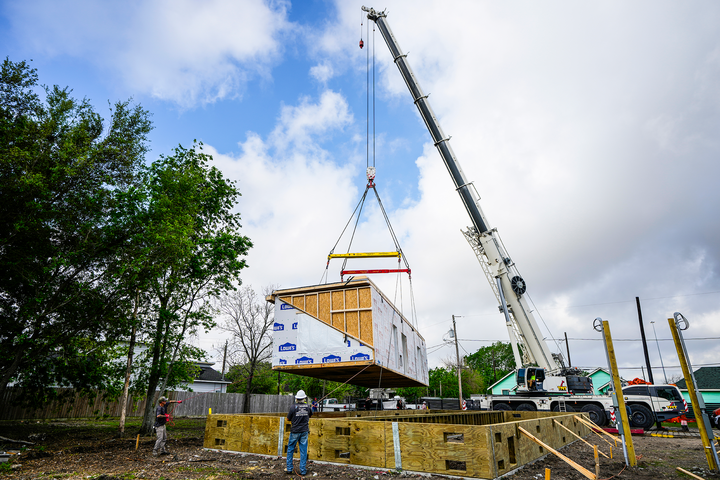
As congressional lawmakers work to address the nation’s affordable housing crisis, manufactured housing is receiving bipartisan support at both the federal and state levels.
Federal policymakers are looking to expand the supply of manufactured homes through the updated 21st Century ROAD to Housing Act that’s moving quickly through the House of Representatives. Meanwhile, several states have moved to reduce barriers to manufactured housing supply. Virginia recently enacted a law that requires local jurisdictions to allow manufactured homes anywhere site-built single-family homes are permitted, following similar laws passed in Kentucky, Maryland and Idaho.
The logic is straightforward: Manufactured homes cost significantly less per square foot to build than site-built homes and already provide housing for more than 22 million Americans, most earning less than the median national income.
Manufactured housing is only truly affordable if it can withstand the environment it’s placed in, however. In a recent Urban Institute report, my colleagues and I find that more than 5 million manufactured homes are in the areas most exposed to climate hazards, and that manufactured housing is disproportionately concentrated in areas exposed to tornadoes, wildfires, and multiple climate hazards.
As policymakers at all levels work to expand the supply of manufactured housing, they should be asking not just how many homes we can build, but how well those homes can perform in the environments where they’ll be placed.
Most manufactured housing is shipped to Southern states with high hazard exposure
To help put this question in context, I looked at where manufactured homes were shipped over the past decade. I analyzed the US Census Bureau’s manufactured home shipment data for 2015–25, finding that:
- More than one million new manufactured homes have been shipped nationwide over the past decade, roughly 10 percent of single-family housing production.
- About 620,000 of them went to just 10 states, mostly in the South and Southeast. Texas alone has received more than 184,000 units.
- The next tier, Alabama, Florida, Louisiana, North Carolina, and South Carolina, each received tens of thousands of homes.
- This pattern has been remarkably stable: The top 10 states have accounted for approximately 60 percent of all shipments in every single year over the past decade.
I then compared these shipment data alongside the Federal Emergency Management Agency’s National Risk Index, which estimates every county’s expected annual loss from natural hazards that are most likely to affect manufactured housing and resident safety (hurricanes, tornadoes, inland flooding, strong winds, coastal flooding, and wildfires). The per capita expected annual loss (EAL) focuses on the relative economic costs of property damage and expected injuries and fatalities, excluding agriculture—providing a good measure of housing vulnerability. In other words, how much personal and property damage are those hazards expected to cause annually, per person?
When I plotted each state’s shipment volume against its per capita EAL, the relationship is clear: Many of the states receiving the highest number of manufactured homes also have some of the highest per capita EAL—particularly Alabama, California, Florida, Louisiana, Mississippi and South Carolina.
And the pattern is accelerating. Six of the 10 fastest-growing states in manufactured housing deliveries are in the South, and North Carolina and South Carolina have more than doubled their annual shipments since 2015. Georgia has nearly tripled theirs.
Federal policymakers have a unique opportunity right now to make manufactured homes safer
The good news is that manufactured housing has a policy lever no other housing type does: A single federal building code that regulates its construction and installation. Whereas the construction of site-built homes is governed by a patchwork of state and local building codes, all manufactured housing is built according to the US Department of Housing and Urban Development’s Manufactured Home Construction and Safety Standards, commonly known as the HUD code. A single update to the HUD code can improve safety standards for every new manufactured home in the country, regardless of where it’s placed.
But the HUD code hasn’t been significantly updated for natural hazards performance in many years, and recent housing policy proposals are silent on this issue. Wind zone maps and design loads reflect conditions from decades ago, not the climate these homes might face through their useful life, and experts say wildfire risks need greater study and attention.
HUD should consider recommendations like requiring that all manufactured homes, regardless of where they are installed, be built to the highest wind zone standards, given the growing frequency and intensity of convective storms and other extreme wind events, and that manufactured homes installed in high wildfire risk areas be constructed using fire-resistant materials.
The ROAD to Housing Act’s major changes to the HUD code, especially the removal of the permanent chassis requirement, create a natural window to consider these safety recommendations and carefully evaluate the resiliency of manufactured homes to the full range of environmental hazards they will face. For transparency, HUD could also support an independent analysis of resiliency recommendations, like the one proposed by Senators Cassidy (R-IL) and Padilla (D-CA) during the Senate’s debate of the ROAD to Housing Act. HUD and federal policymakers will need to carefully assess how recommended resiliency enhancements affect affordability, but industry-wide adoption of those standards will drive down costs and incentivize innovation.
Design and construction standards are critical, but they are not the whole picture. How a manufactured home is installed matters just as much. A well-built home that is poorly installed fails in the same wind that a properly anchored home survives. Benchmark installation standards, which HUD also sets, and their enforcement deserve the same attention as the construction standards themselves.
State and local governments also have a role. Avoiding hazards altogether is the first line of defense for housing, and local governments hold the key to those decisions. As they work to remove barriers to manufactured housing growth, local governments should pair those reforms with resilience-focused zoning and land-use policies that account for local flood, wind, and wildfire risk.
Over the past decade, the US manufactured housing industry provided more than one million homes to American families. The next million can and should be safer, and the policy tools to make that happen are already in place.
Thanks to Sara McTarnaghan and Cole Campbell for their contributions to this article.