Solving the current housing crisis requires that all governments work together to produce and preserve affordable housing. But public agencies are often balancing how to allocate their scarce dollars in ways that address housing shortages, especially those of affordable units, with other policy goals, like strengthening local economies.
Our new report shows the decision doesn’t have to be a trade-off. Analyzing 45 recent multifamily housing projects in Oklahoma that received low-income housing tax credit (LIHTC) equity, we found that financing the production and rehabilitation of affordable housing also delivers economic benefits alongside its core social mission. These projects are associated with the creation of more than 4,000 jobs and over $800 million in economic output, and for every $1 of public investment, 43 cents flow back to public coffers through tax revenues.
Oklahoma’s experience makes a compelling case for other localities: Investing in affordable housing doesn’t just provide the shelter people need. It functions as a strong economic development tool, generating returns comparable to, and often exceeding, other public infrastructure investments.
LIHTC projects contribute significantly to local economies and tax revenues in Oklahoma
Collectively, the 45 affordable projects in our sample added 2,667 homes across Oklahoma, and they were financed with $220 million in federal LIHTC equity and $75 million in state tax credits. These homes will ensure quality, affordable housing for thousands of Oklahomans, but they are also estimated to create:
- 4,043 jobs supported during the construction phase and 57 while operating. This is the equivalent of the jobs expected from the recently announced Inola aluminum plant, projected to be the largest primary aluminum production plant ever built in the United States;
- nearly $276 million in labor income generated during construction, equivalent to the total annual income of more than 2,100 typical Oklahoma households, in addition to $16 million in labor income generated during 10 years of operation;
- more than $400 million in value added to Oklahoma’s economy during construction, comparable, on an annual basis, to the revenues generated by the University of Oklahoma Sooners, in addition to $167 million over 10 years of operation;
- nearly $814 million in total economic output during construction, which is more than double the projected economic output of the Roosevelt Memorial Bridge modernization project spanning Lake Texoma , in addition to $186 million over 10 years of operations; and
- over $126 million in tax revenues generated during construction and 10 years of operations. This means these projects will return more than 43 cents for every dollar of state and federal tax credit investment through taxes.
For every $1 invested through federal and state tax credits, these projects generate significant returns, as seen on the figure below.
Affordable housing’s economic ripple effects
Construction activity generates direct employment for a range of workers, such as laborers, electricians, plumbers, architects, and project managers. That spending then ripples outward through indirect effects, such as purchases from building materials suppliers, equipment vendors, and professional services firms. They also produce induced economic effects, as workers spend their earnings at local grocery stores, restaurants, and service businesses.
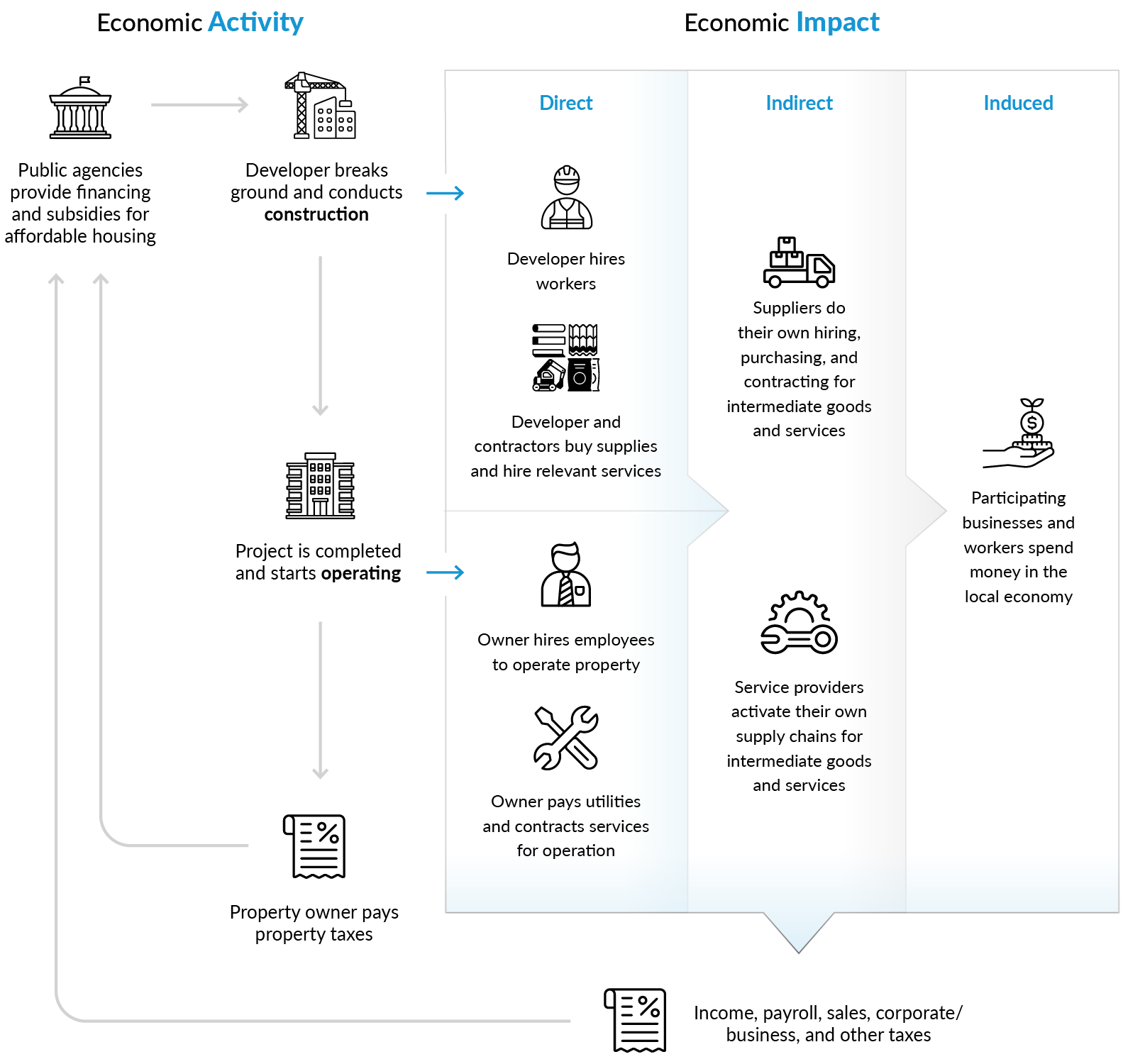
While the economic impacts of housing construction are quite visible, housing sustains economic impact during the operations. The same cycle continues at a smaller scale, with property management, maintenance, and administrative staff spending their wages in the local economy, and property taxes flowing to county and local governments.
This standard economic multiplier logic is especially powerful for housing construction, because the industry relies heavily on local labor and in-state suppliers. Other types of infrastructure projects, such as transportation infrastructure, can be more capital intensive and rely more heavily on specialized materials and equipment sourced outside the region, leading to comparatively smaller in-state multipliers.
Local economic conditions shape LIHTC project effects
Affordable housing investment influences both urban and rural areas. Projects in the Oklahoma City and Tulsa metropolitan areas generate somewhat higher economic returns per dollar invested, $4 in output per dollar of tax credit equity, compared with $2.60 for nonmetro projects, partly because urban economies are larger and more diversified, capturing a higher share of project spending locally through supply chains and consumer spending.
This does not mean that rural projects should be dismissed or deprioritized. These LIHTC projects serve communities with persistent housing shortages, and still generate meaningful economic activity: more than $0.37 in tax revenue per dollar of tax credits allocated.
New construction projects, predictably, generate higher total economic impacts than acquisition-and-rehabilitation projects because they are more capital intensive. But on a per-dollar-of-tax-credit basis, the two types of projects perform comparably, suggesting that both are sound uses of public investment depending on what a community needs and the state’s goals.
How states and localities can expand the economic impacts of affordable housing
The economic returns to a state from affordable housing investment are notable, and they can be augmented or diminished based on how project spending circulates through a local economy.
Policymakers can help strengthen those returns by investing in the in-state construction ecosystem. This could include funding or supporting workforce development programs that expand the pipeline of skilled tradespeople, creating incentives for state-based building materials suppliers and manufacturers, and requiring or encouraging procurement strategies that favor the use of local contractors in publicly supported projects in ways that do not raise overall project costs. The goal is to ensure that more dollars invested in affordable housing stay in Oklahoma, even in rural communities where supply chains are thinner.
The tax revenue findings carry a practical message for budget planners as well. During construction, most tax revenues flow to the federal government. But once a project is occupied, the balance shifts sharply: Roughly 79 percent of ongoing tax revenues are collected by state and local governments through property taxes, sales taxes, and income taxes tied to operations. Local governments should plan for this delayed but sustained revenue stream and incorporate it into long-term budget forecasts.
As Oklahoma and other states consider their path forward on housing, these data offer a clear message to policymakers: Investing in affordable housing is not a simple trade-off between social need and fiscal responsibility. It can be a strategy that advances both at once, by creating jobs, strengthening local economies, generating tax revenues, and providing stable homes for families.
Let’s help communities build more secure, hopeful futures.
Today’s complex challenges demand smarter solutions. Urban brings decades of expertise to understanding the forces shaping people’s lives and the systems that support them. With rigorous analysis and hands-on guidance, we help leaders across the country design, test, and scale solutions that build pathways for greater opportunity.
Your support makes this possible.